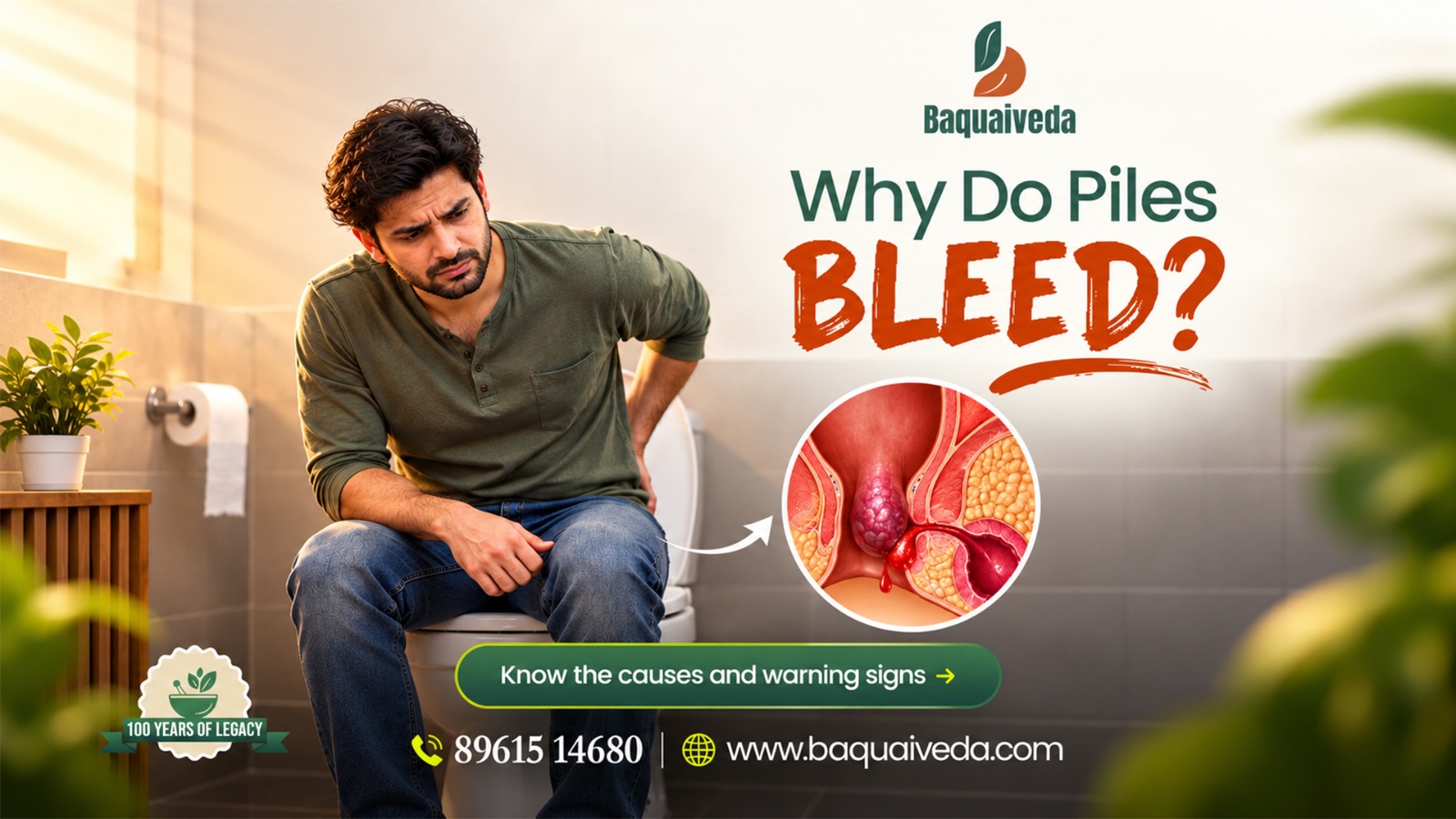
You finish your business, wash up, and there’s blood. In the bowl, on your hand, maybe on your underwear. Your stomach drops. First thought: “Is this serious?” Again, many think, “I am definitely not telling anyone about this.”
Piles (arsha) are one of the most common causes of blood in the stool. However, here’s the thing: common doesn’t always mean harmless, and that’s where people get confused. Let’s sort it out.
What Exactly Are Piles?
Piles (haemorrhoids) are basically swollen blood vessels in and around the anus. Everyone has soft cushions of tissue there that help control stool. Trouble starts when those cushions swell and stretch.
- Internal piles: They sit inside the rectum. They’re usually painless, but they bleed.
- External piles: This type forms under the skin around the anus. They tend to itch, hurt, or feel like a lump.
Why do piles bleed?
The veins in this area are thin-walled and delicate. When hard stool pushes past a swollen cushion, it scrapes the surface and the vessel leaks.
The blood is often bright red. It may appear on toilet paper, on the surface of the stool or in the toilet bowl. However, the colour and position of the blood cannot confirm that piles are the cause.
Could Your Daily Routine Be Causing Your Piles?
Piles can develop when the blood vessels around your anus and lower rectum come under too much pressure over time. Here’s what usually puts it there:
- Constipation and straining. The biggest trigger. Hard stools make you push, and pushing swells those delicate veins.
- Low-fiber, low-water eating. Refined food, fried snacks, and big rice-heavy meals without enough sabzi, dal, or fruit make stools harder to pass. Too little water makes it worse, and Kolkata’s humidity can leave you more dehydrated than you realise.
- Long hours on the toilet. That “quick” phone scroll adds up. Sitting there lets blood pool in the area.
- Sitting too much overall. Desk jobs and long commutes slow your gut down. Ignoring the urge to go because you’re stuck in traffic or on a bus doesn’t help either.
- Diarrhoea. Frequent loose motions irritate and strain the area just as much as constipation.
- Pregnancy, excess weight, and heavy lifting. All of these raise pressure inside the abdomen.
- Age and family history. The supporting tissues weaken over time, and piles do tend to run in families.
And the “garom” food myth? Spicy food doesn’t cause piles. It can irritate them if you already have them, so it’s more of an aggravator than a cause.
When Is Rectal Bleeding A Warning Sign?
Bleeding does not automatically mean piles. Anal fissures (small tears), polyps, inflammatory bowel disease, and colorectal cancer can also cause rectal bleeding. Piles can co-exist alongside these conditions, so blaming piles without checking can delay a proper diagnosis.
See a specialist soon if you notice:
- Blood that’s dark red or maroon, or black, sticky stools
- Blood mixed through the stool
- Bleeding that lasts more than a week or two, or keeps coming back
- A change in bowel habits that persists for a few weeks.
- Unexplained weight loss, constant tiredness, or looking pale (slow bleeding can cause anaemia)
- Age above 45, or a family history of bowel cancer
If you are bleeding heavily, or feel dizzy or faint, get medical help straight away. According to 2026 research by the Cancer Research Institute, bowel cancer is also being seen more often in younger adults, so being young isn’t a safe reason to wait.
Small Habits That Can Make Piles Less Painful
Everyone asks for the best way to get rid of haemorrhoids, and the honest answer is that it depends on the type, the size, and what’s causing them. If your piles are still mild, a few small habits do a lot of the work:
- Add fibre: seasonal sabzi, shaak, dal, whole wheat roti, papaya, guava
- Ask your healthcare specialist about isabgol (psyllium husk) with plenty of water
- Keep yourself properly hydrated throughout the entire day
- Don’t strain, and don’t hold in the urge to go
- Keep toilet time short, and leave the phone outside
- Wash gently with plain water and pat dry with a soft cloth
- Try a warm water sitz bath for 10 to 15 minutes
Want to get rid of external haemorrhoids without surgery? For mild cases, these same habits, along with a proper check-up, often settle the swelling.
Where Does Traditional Medicine Fit Into Piles Care?
Both of these traditional medicines see digestion and constipation as the starting point for piles. So the focus is on keeping stools soft and the gut regular while easing swelling and discomfort.
Unani medicine for piles often uses herbs with traditional roles in two areas:
- Swelling and irritation: Gogul (guggul resin) and Bakain (Persian lilac) have traditionally been used to help calm swollen, inflamed tissue.
- Easier bowel movements: Sana (senna) and Halila Zerd (yellow myrobalan) have traditionally been used to help stools pass more comfortably, which means less straining.
Senna, especially, is a stimulant laxative, so it isn’t meant for long, unsupervised use. Some herbs also aren’t suitable during pregnancy or alongside certain medicines. That’s why picking herbs off a list and self-medicating isn’t a great idea.
If you’re exploring Unani and Ayurvedic treatment for piles in Kolkata, choose a qualified practitioner who examines you properly, explains what they’re prescribing, and tells you when further tests are needed. These systems can support your care.
Don’t Let Embarrassment Hold You Back
Talking about piles may feel uncomfortable, but your health deserves more attention than your hesitation. Rectal bleeding isn’t something to ignore or self-diagnose.
With a 100-year legacy, Baquaiveda, a Unani and Ayurvedic clinic in Kolkata, offers consultations to help you understand your symptoms and explore suitable care options.
Noticed blood? Don’t let embarrassment delay the care you deserve. Get it checked.